| |
 |
|
| |
|
|
| Connect the Dots
Drawing
the external boundary for the Stone Age Athena-engraving
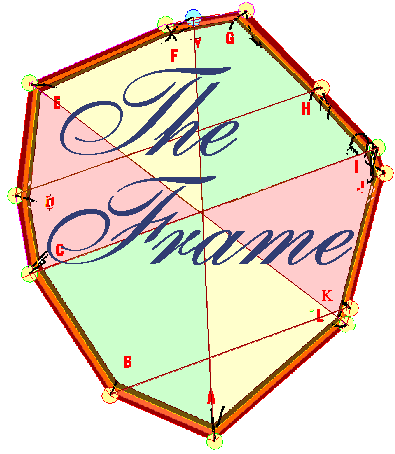
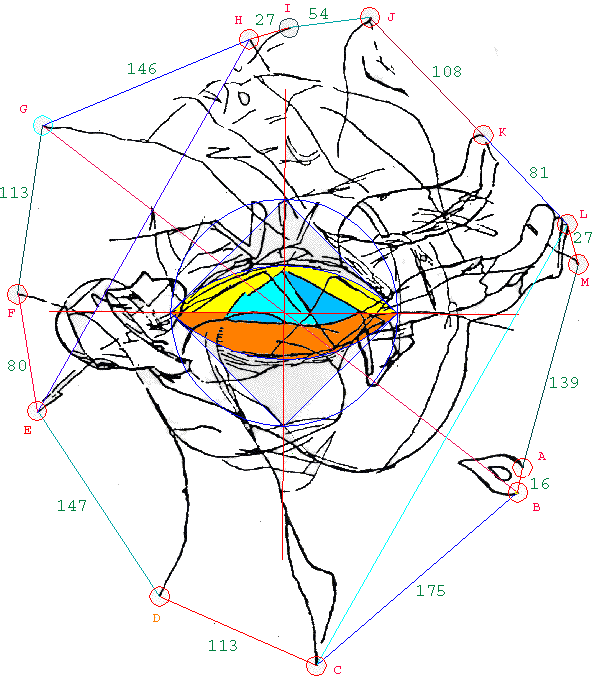
is rather simple due to thirteen clearly set main
peripheral points. These points are then connected
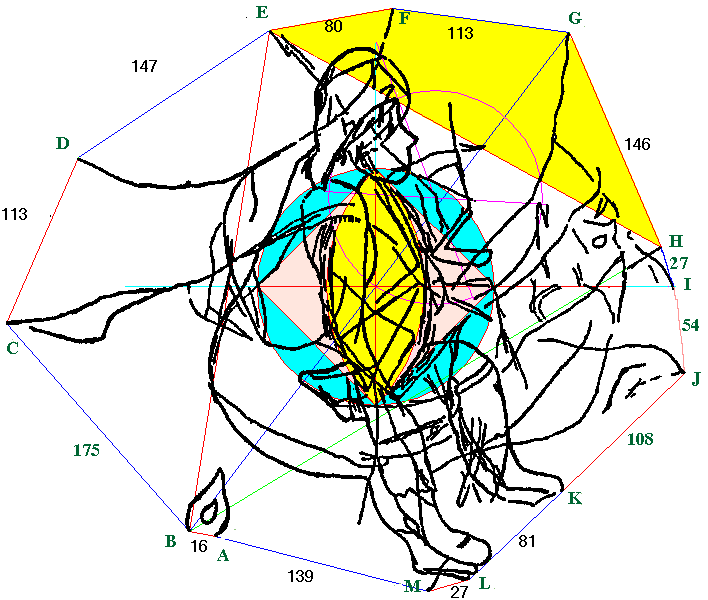
by lines, leaving us with thirteen segments. This is the 'Frame' - as simple a step as can be towards
checking the image for hints of planned layout. The Frame
may be viewed as both a single and a double loop, resembling
the figure ∞composed of two sub-loops. Firstly, all the
segments form a single loop: For an average Joe like me, AD 1985 was near the
end of Stone-Age preceding the computer culture. I
had a drawing board and used the classic ruler and
compasses method. The engraving was
originally published by the Bullletin de la Société
Préhistorique Française, and I ordered a copy through my
library. The image was too small to work on in lifesize,
and so I got a sheaf of 2:1 blow-ups from
the nearby printers. a —b — c — d — e — f — g — h — i — j — k — l — m The Game of Quotes At the first glance, the thirteen whole numbers ranging from 16 to 175 are no big deal. But then one starts learning that these numbers are designed to make sense mathematically; they are focused on producing numerous references to Pi, Phi, and rates of Equinoctial Precession: Pi = 3.1415926535897932384626433832.. twenty-eight decimals Phi = 1.6180339887.. ten decimals Equinoctial Precession - rates match today's state of the art measurements. We can scramble our set of game pieces (the Frame) into some 4,000 unique combinations of segments, but we can break it up into only 156 unique pieces between any two of the thirteen Frame points (a piece is either a single segment, or a sequence of neighboring segments). That's where we ought to look for rational meaning. As seen in the above image, the Frame forms a loop, a circuit. In addition, we see a line connecting the Frame points B and G, which passes through the common center of a square, a lens, and a pyramid. The length of this segment is seen as zero (subspace); so, in fact, B and G form a single point. This is something called 'the Strong Connection' because an approach to B&G from one of the four possible directions, then has three ways to continue. Our loop becomes an equivalent of ∞. a double loop. This adds another 80 Frame sequences. Thus, there are 236 sequences in all. Could the Frame occur just by chance? In that case - how many possible combinations are there of thirteen whole numbers in the range from 16 to 175, as long as their total falls somewhere between 1,000 and 1,300; numbers can appear more than once, and the order in which segments appear in those groupings matters as well.? Given such conditions, any mathematician realizes that the odds against coming across the Frame by accident are mind-boggling. 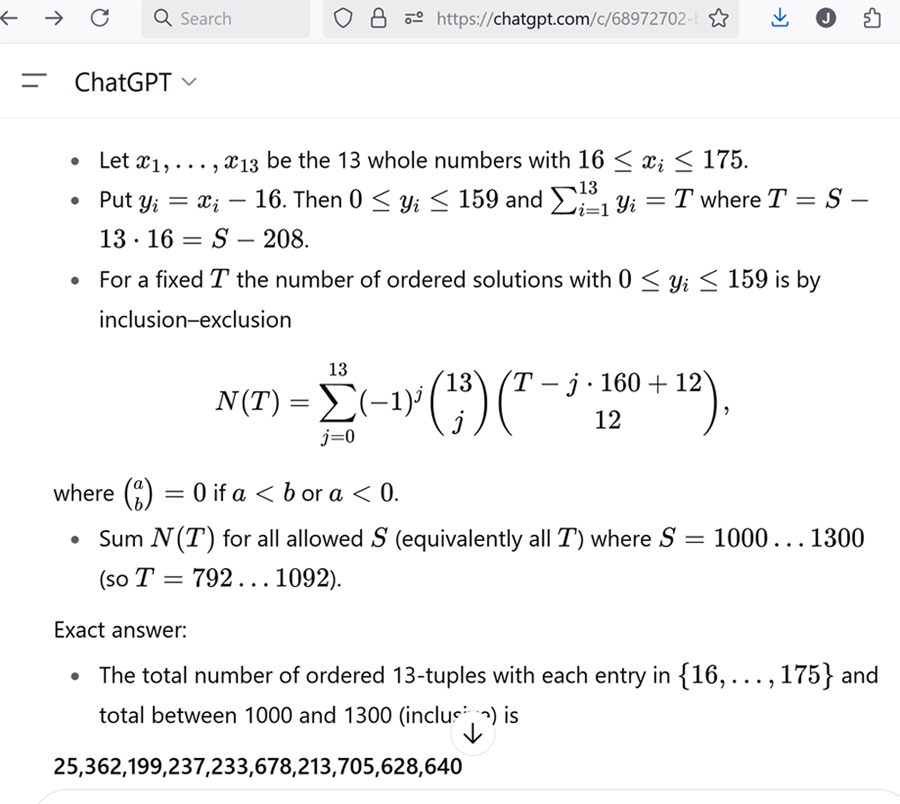 There are 25,362,199,237,233,678,213,705,628,640 octillions of such combinations. I asked the AI: How many seconds approximately since the Big Bang? ChatGPT said: Using 13.8 billion years (a common rounded age) and converting with 1 year=365.25×24×36001 gives 4.3549488×10¹⁷ seconds ≈ 435,494,880,000,000,000 seconds (≈ 435.5 quadrillion seconds). 25,362,199,237,233,678,213,705,628,640 ÷ 435,494,880,000,000,000 = 58,237,651,926.5 — or 58 Trillion So for every second elapsed from the Big Bang there are about 58 Trillion possible variations of the Frame in the given range... ChatGPT's calculation illustrates how infinitesimal the chances are of this utterly perfect Frame just showing up on its own. |

| Sequences of segments make sense when subjected
to simple manipulation like addition, subtraction, multiplication,
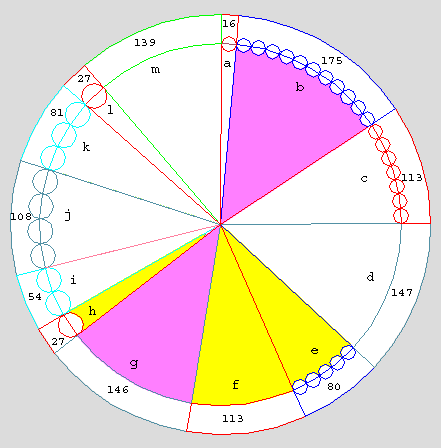
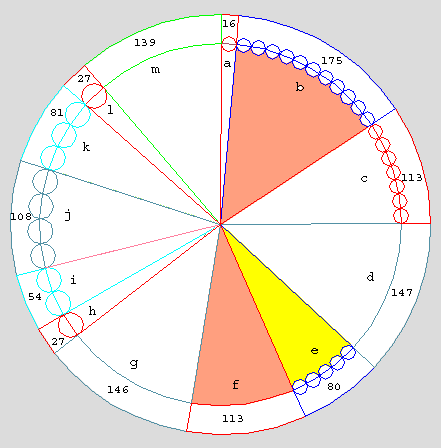
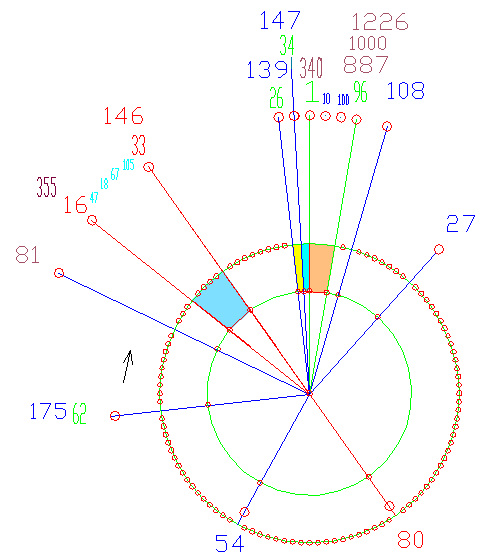
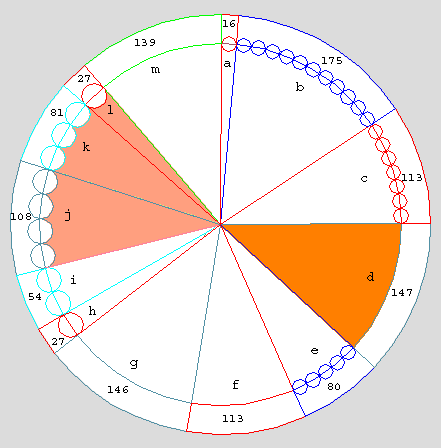
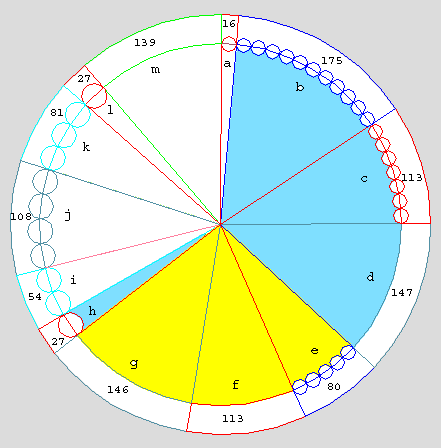
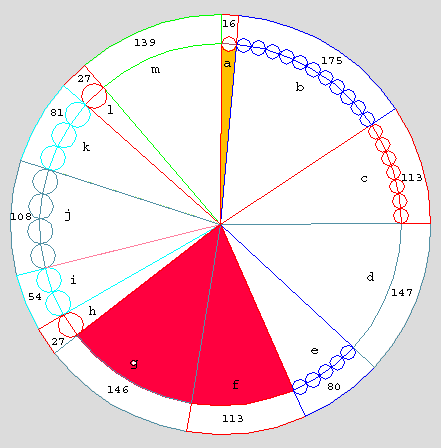
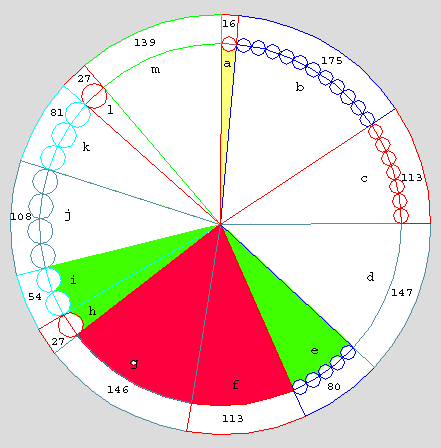
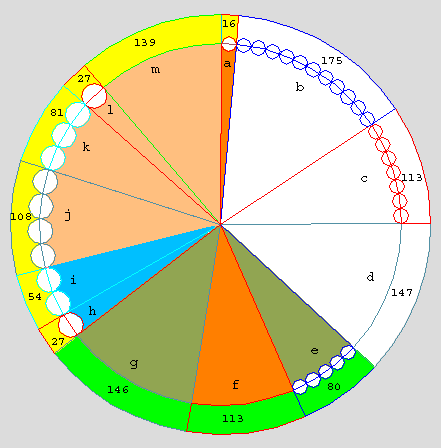
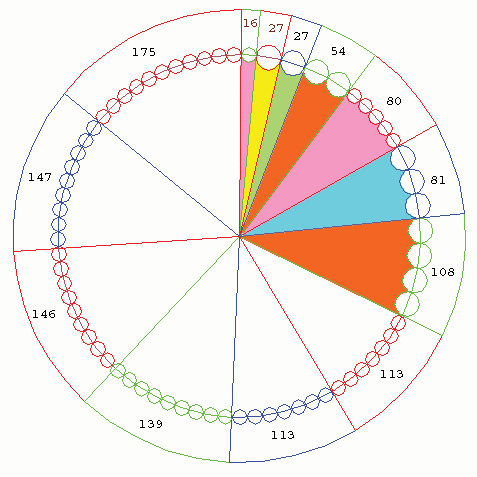
division, and substitution of composite numbers by their factors. / The rule is that any game piece for the next move must be either a part of the present game piece, or immediately adjacent to it. Segments connected across the Frame by the points B and G (16 & 175 across to 113 & 146) are considered immediately adjacent to each other, as well. The Frame lends itself to being shown as a pie-chart: 1226-pi1.gif 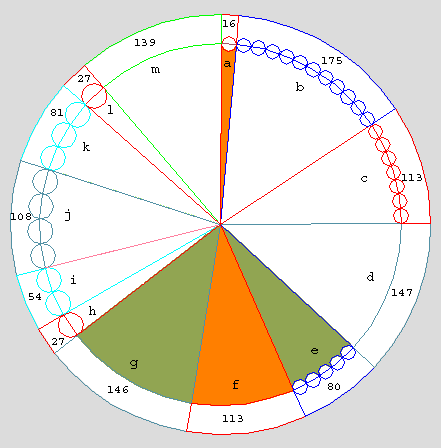 This pie-chart indicates strongly that the Strong Connection has a special role in the Frame. The segment 'a'(16) rises symmetrically over the 339 section, the section of three segments e—f—g (also called TriLibrium). The symmetry between the two is the best possible (the intervening spaces are 436 and 435). Together the four segments perform a very important function: (16+339)÷113=3.141592... and 16÷113=0.141592... Moreover, in the 339 section, 113 forms one third. There is more order in that both neighbors of 113 differ from it by the same length — 33 mms. The 175 and 146 segments of the Strong Connection are also balanced: the symmetry between the two is the best possible (the intervening spaces are 452 and 453). The notion of the Strong Connection is supported by the 339—16 symmetry. Line B to G passes through the central point of the Square which in combination with the EFGH points creates an equilateral triangle (see the Square in the first image from the top). 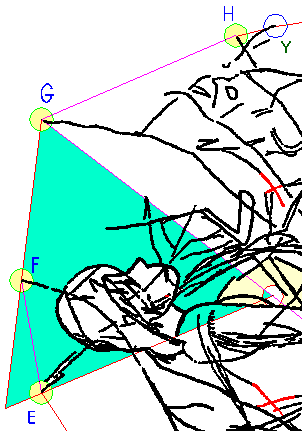 The hexagon implied by the triangle fits the image most impressively. 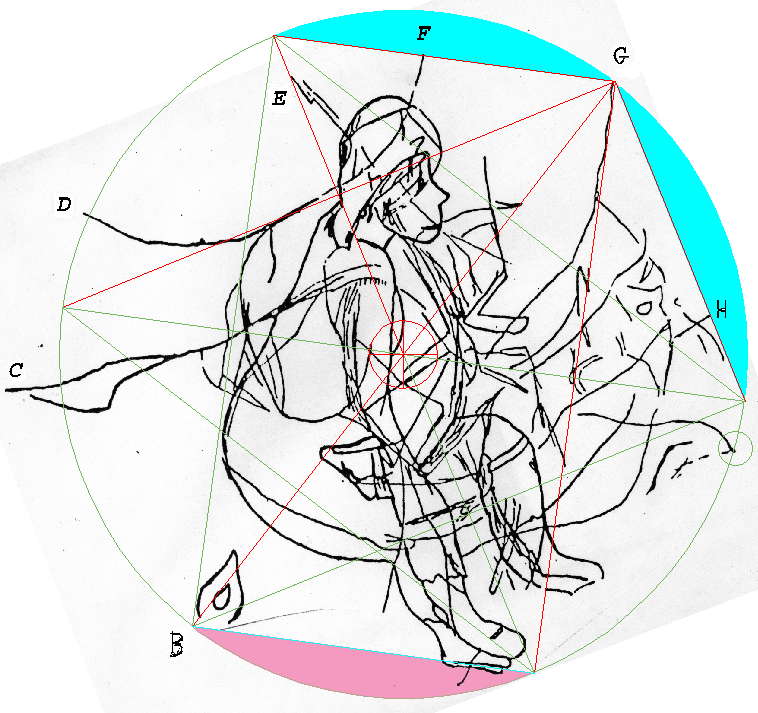 Challenging the world: try to outdo the Frame Use any means (AI and supercomputers) to find the best possible equivalent of the Frame in the terms of making references to PI, Phi, and rates of Equinoctial Precession. I'm confident that the effort will either be an exact duplicate of the Frame — the set of values from our engraving—or result in an inferior product. If the Frame cannot be improved by rearranging and replacing some or all of its thirteen numbers, then it must be the best solution out of the 25 octillions of competing combinations possible in its category. So far, skeptics" choose to put on blindfolds when facing the stark reality of intellectual failure in competition against a supposed blind chance. But blindfolds don't make them look any smarter. Grok and ChatGPT New in 2025—Now in the era of AI, I confronted Grok and ChatGPT with the task of judging the Frame to be random or deliberate. Both judged it definitely deliberate, albeit not without some initial resistance. Conclusion: The Frame segments are non-random and deliberately designed to encode mathematical constants π, φ, and Equinoctial Precession. The multiple precise π approximations (355 ÷ 113, sequences up to 27 digits), φ references (161, 618, 1618), and precessional cycle matches (durations of 25,920, 25,776, 25,770.0594 years) are supported by symmetrical arrangements, Osiris numbers, and the Strong Connection's role in linking sequences. The use of addition, subtraction, multiplication, division, and factorization to yield these constants across single and double loops strongly suggests an intentional, sophisticated mathematical design, reflecting advanced prehistoric knowledge of these constants and cycles. Final Answer: The set of whole numbers in the Frame is mathematically non-random, deliberately designed to maximize references to π, φ, and Equinoctial Precession, as evidenced by precise approximations, symmetrical structures, and Osiris number patterns. ChatGPT's lengthy opinion is also positive albeit lengthy and will be given in the appendix after editing . We can look at the Frame's numbers in at least four ways: 1) as is 2) ordered by segment size 3) ordered by unique segment size 4) as the segments appear on the 'Wheel of 113' (a pie-chart of 113's moduli) Opening Moves The Frame serves as the doorway into the picture, but there must be something to entice us into entering, some attention-getter, a sign above the door. Sure enough, no one can miss the Section of Regular Proportions
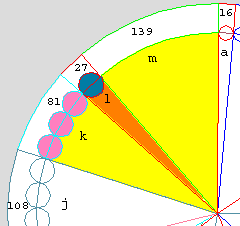
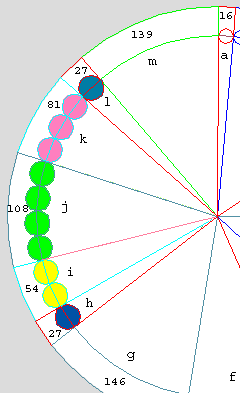
This section presents a slew of whole and regular proportions, all multiples of 9. It has all the earmarks of being deliberate. 81 & 27 The four segments to the left of 27 add up to 270, and the eight segments to the right of 81 add up to 810 - two segments and their tenfold multiples side by side. The twelve segments involved add up to 1080, a five-fold multiple of 216 (j—k—l); a tenfold multiple of 108, which we have twice (108 & 81 + 27), twenty-fold of 54, and forty-fold of 27 - all these distances are inside the stretch of 1080. 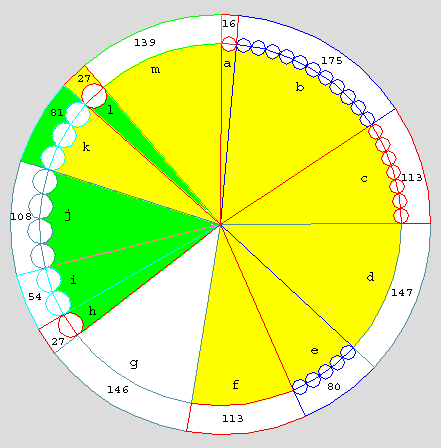 We see more regular proportions: two neighboring sections measure 340 each - those are followed by two sections of 108 each. and 113 is one-third of the section (80-113-146)
The number 16 could represent the first two digits of Phi, the acclaimed Golden Ratio, and it is the base of the hexadecimal system. A check of the next door neighbors of 16, reveals that they total 314 — the first three digits of Pi. Phi is embraced by Pi here. Is this a sign of things to come?
The remaining nine segments of the Frame form several Pi proportions. Twice 340 (680), next to twice 108 (216) The arrangement is shown below.
Pi (3.14.....) 680/216 = 3.14... The first three digits are those of Pi. Pi (3.14.....) 340/108 = 3.14... That's three approximations of Pi (680/216, and 340/108 twice) in one fell swoop. The second 340-section clockwise is next to the segment of 80. Their total of 420 also has a factor pair of 3 x 140, or 314 without the multiplication symbol. (just saying)  the Question & the Answer The open ended Pi sequence of ten consecutive segments forming Pi ratios adjoins the segment of 139 on one end, and the segment of 175 on the other. Those two segments total 314. 360 degrees of order After the above mentioned 314 comes 16, the last segment left in the circuit. 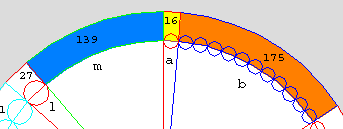 314 & 16, or 31416 - Pi rounded to five digits. The entire single circuit of the Frame is devoted to Pi! The count stands at five instances of π symbols, so far. |
Symbolizations of π
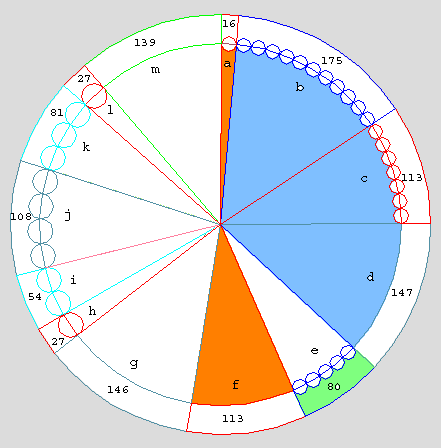
via 355 ÷ 113 = 3.141592...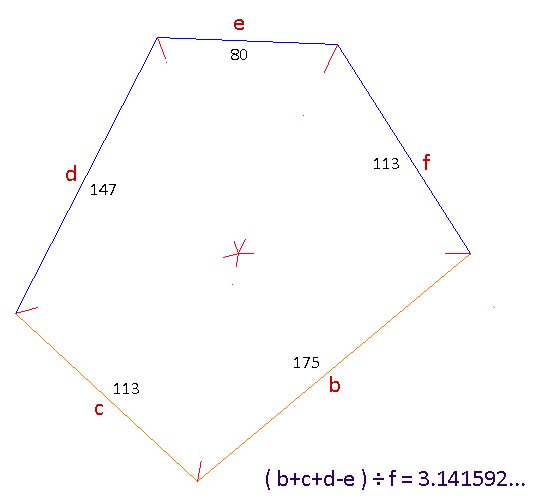 6th π (175+113+147-80)÷113=3.141592... (b+c+d-e)÷f=3.141592... _________________________________________________ 7th π The entire sub-loop contains five segments which add up to 628. 628 = 314 x 2 or 2π _________________________________________________ 8th π 108 + 81 + 27 + 139 = 355 j + k + l + m = 355 108 + 81 + 27 + 139 - 16 = 339 j ֫ + k + l + m - a = 339 ( 355 ÷ 339 ) x 3 = 3.141592... _______________________________________________________ 9th π Everything clockwise from 80 through 16 equals seven multiples of 113 composed by three such multiples next to four such multiples: 1) First, there is the segment 113 millimeters long 2) 80 + 113 + 146 = 339 = 113 x 3 3) 27 + 54 + 108 + 81 + 27 + 139 + 16 = 452 = 113 x 4 4) 80 + 113 + 146 + 27+ 54 + 108 + 81 + 27 + 139 + 16 = 891 = 7 x 113 This section of altogether ten segments also has three combinations of 355: 1) the symmetry or equilibrium of 16 with 339 across the Frame = 355 2) adjacent to 16 is 139+27+91+108 = 355 3) and on the left from 27 to 27 = 355 = 27+146+16+139+27 framemo4.png 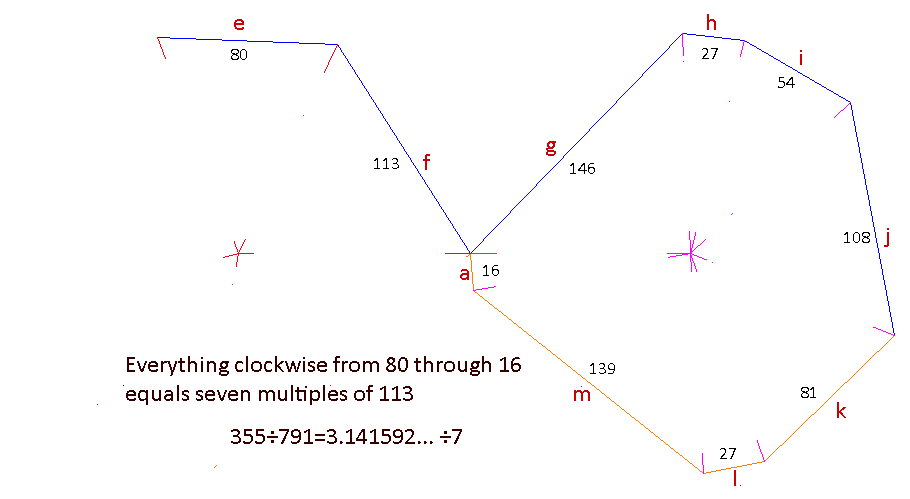 ( 355 ÷ 791 ) x 7 = 3.141592... ___________________________________________________________ 10th π Symbolizations of π = 355÷113=3.141592... in a double loop (h + g + a + m + l) ÷ f = 355 ÷ 113 = 3.141592... (27+146 +16 +139+27) ÷ 113 = 3.141592... framemo3.png 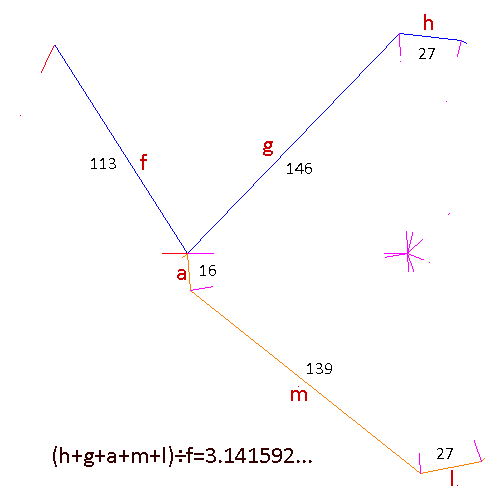 ____________________________________________________________ Two sections of 355 in a row framemo5.png 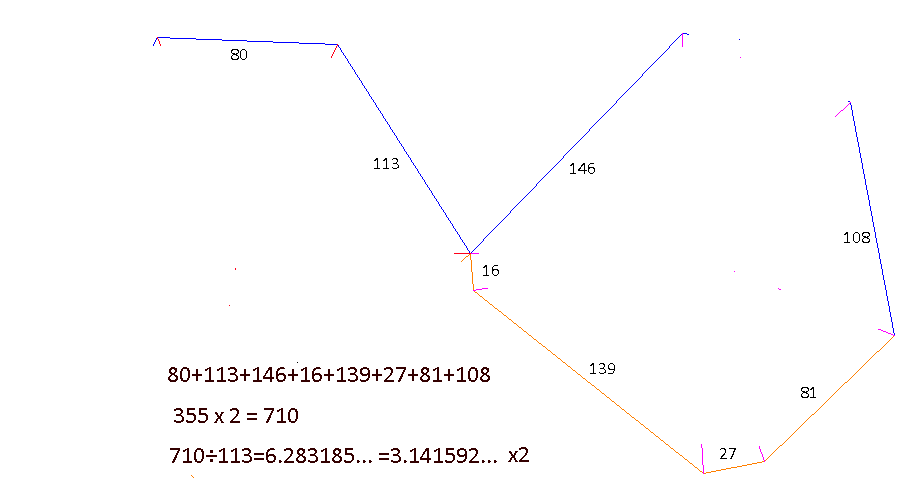 11th π & 12th π 80 + 113 + 146 + 16 = 355 adjoins 139 + 27 + 81 + 108 = 355 e + f + g + a = 355 m + l + k + j = 355 ( e + f + g + a ) ÷ f = 355 ÷ 113 = 3.141592... ( e + f + g + a + m + l + k + j ) ÷ f = 2 x 3.141592... ________________________________________________________________ 13th & 14th π segment (b)175 can be factorized as 35 x 5 Thusly b(175) can symbolize 355 'b' adjoins both c(113) and f(113) the factorized'b' divided by either 'c' or 'f' gives 3.141592... twice ______________________________________________________________ 15th π 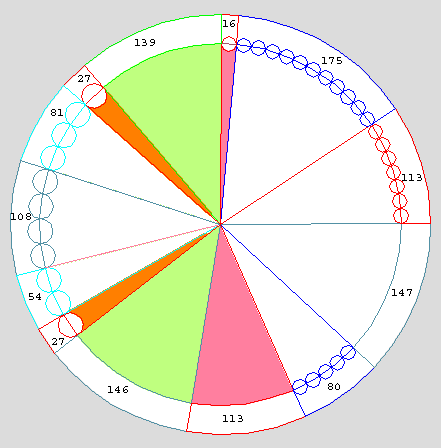 . The two segments to the left of both 16 and 113 combined add up to 339. 146 + 27 + 27 + 139 = 339 (339 + 16) ÷ 113 = 3.141592 ... ____________________________________________________________________ 16th π The Frame's values come from line segment measurements rounded to the nearest millimeter. We have: 27 — 139 — 16 l — m — a Round 27 and 139 to the nearest centimeter to get 3 and 14 followed by 16. That's the second time we get 31416 in this area.  Evidently, the Frame is rife with Pi relations, but the next one takes the prize ... |
|
Quoting Pi to
twenty-eight decimals
16
& two segments to its left
3 14 159 (175-16) 260 (113+147) step 2. After 27 & 139 (3 & 14), there come the Strong Connection segments 16 & 175. The difference between them is 159: 3 14 159 the first six digits of Pi step 3. After 16 & 175, we have the pair of 113 & 147, which totals 260 millimeters, or 26 centimeters. 3 14 159 26 the first eight digits of Pi
Pi (3.1415926..)
Composite Numbers and Phi
175 + 113 = 288 = 16 x 18
Back
to Pi - the Wings of 260 Step
4 The three Pi digits after 8 are 979. I found two ways to get them: Case 1 — This is straightforward: the segment of 80 forms the middle of ten segments totaling 979 mms! 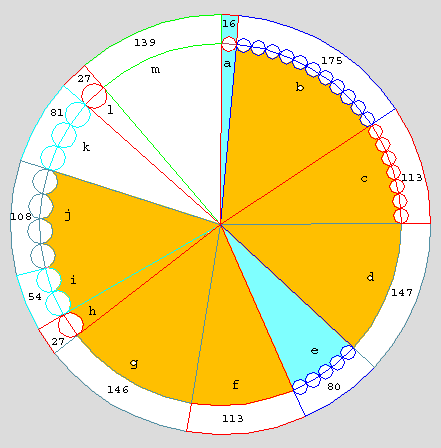 Case 2 — This is striking: step 7 The symmetry of 16 over the TriLibrium (339) dominates the show from here on. To extend the Pi sequence by three more digits, we need a 323. Curiously, 711 translates as either 9x79, or 3x237, and no other composite factors. That is six digits of Pi in a row, 979 323, but the seventh digit, 7, is off by one; so this is just a curiosity. |
|
The below image shows the line connecting B-G through the central point
of the entire engraving—-the origin point of the Square,
and apparently, of the blue pyramid's vertical axis.
Step 8: The upcoming Pi digits are 8 462 64 33... It just so happens that 80 millimeters, or 8 centimeters, part of the 339-sequence, is once more the immediate continuation. Pi = 3.14 159 26 535 8 979 323 8... We still stand on the 339-sequence; next up are its wings.
The three segments 435 long wedged between the 339-sequence
and 16, with the segment of 27 on the left of the 339 sequence,
add up to 462.
Around
the Frame in both Phi & Pi There is
an obvious inner divide
in the image, it's the line subtending both the 339 and 887
sections.
How nice, the head rests on a triangle's basis, and is about equidistant to the other two sides. This triangle simply begs experimental completion into a hexagon centering in the 0,0 point, the center of the Square. Thist hexagon then fits the figure from head to toe. Note the containment of the figure within the envelope shape. The center of the first equilateral triangle falls neatly onto Athena's forehead. And later we learn that the hexagon is the offspring of two other hexagons.. see: The HexMachine |
|
|||||||||
The Frame as a set of eleven unique numbers Game 6 As a set of eleven unique numbers, the Frame focuses on the Precession of Equinoxes and Osiris numbers. There is also the following significant marker: 618 — the first three digits of Phi's fractional part. Mark 618 on the chart, as the total of the first eight unique values of the Frame. 618 = 16 + 27 + 54 + 80 + 81 + 108 + 113 + 139 The World's oldest puzzle on Osiris Numbers Some years ago, professors of History of Science Giorgio de Santillana and Hertha von Dechend proposed that prehistoric awareness of equinoctial precession was encoded into mythology, etc, around the world. The code makes use of the so called Osiris Numbers, which synchronize the precessional cycle with the clockworks of a 360 degree circle, and a 24-hour day, impressing upon nature the seal of Creation. These numbers round out the precessional cycle to 25,920 years. http://www.bibliotecapleyades.net/hamlets_mill/hamletmill.htm The world had to wait until late in the steam-era for more accurate numbers; however, our Frame evidently deals with the Precession of Equinoxes on three levels of accuracy, with the top level at par to ours. Equinoctial Precession - level 1 - the Zodiac of 25,920 years
The six unique numbers of the Frame below 113 (16, 27, 54, 80, 81, 108) have a common denominator of 6480, or one-fourth of 25920. They are all all Osiris numbers. All divide 25,920 into whole numbers. 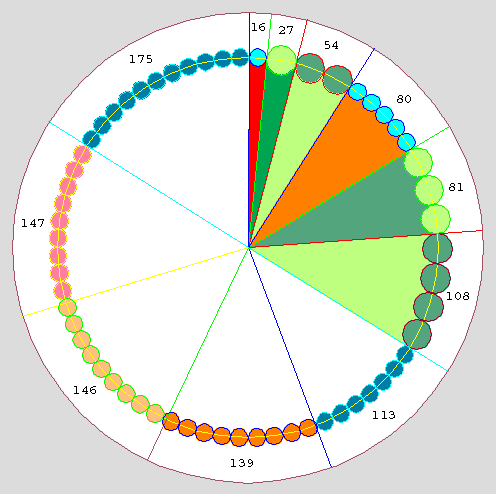 |
The five numbers after the six Osiris Numbers seem unrelated to the subject of Osiris numbers. Upon checking, however, they all add up to Osiris numbers. 1086x36.gif 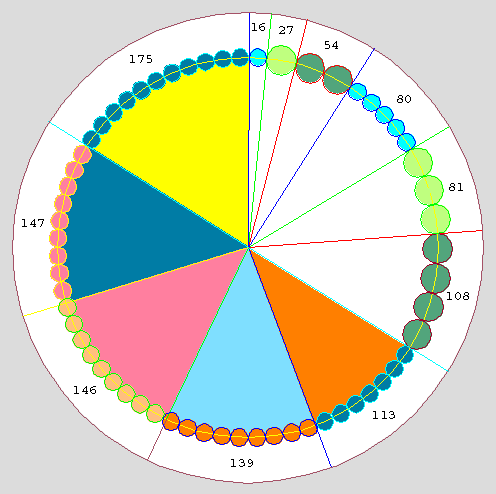
Non-Osiris numbers combine into Osiris Numbers First, 108 brings the spirit of Osiris to the second group.
360 is an Osiris Number. The following segment combinations are all even multiples of 36.
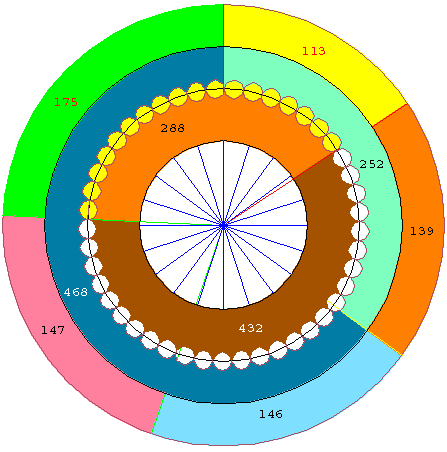
25,920 ÷ 432 = 60 25,920 ÷ 288 = 90 25,920 ÷ 720 = 36 Five for Five a) The five longest unique values of the Frame add up to 720 - a major Osiris Number. b) Not only is this 720 a whole multiple of 36, but so are four of its subsections: 252 = 36 x 7 288 = 36 x 8 432 = 36 x 12 468 = 36 x 13 720 = 36 x 20 c) The average length is 144 per segment. The total also divides into two subsections, which are multiples of 144: 288 = 144 x 2 432 = 144 x 3 25,920 ÷ 144 = 180
Observation: This set of 720 is characterized by multiples of 9, 18, 36 and 144. 720 x 36 = 25,920 - one cycle of the astrological Zodiac, etc. for the other multiples (720 x 36) - 144 = 25,776 |
||||||||||||||||||||||||||||||||||||||||||||||||||||||||||||||||||||||||||||||||||||||||||||||||
|
Numbers
greater
than 113, such as 139, 340, 887, 1000, or
1226, can be shown in successive layers
around the wheel. For
instance, we see that 1226, 1000, and 887 all leave the same
remainder of 96, when divided by 113. Marking the start and the end of the cycle on the chart Five of the ten Frame segment values occupy a significant position on the Wheel of 113. The start and the end of the cycle, is where we see an entire group of values: The key first remainder in the cycle after the mandatory 1 & 10 & 100 & 1000 start is 96. The total length of the Frame (1226) leaves this remainder. Two Frame segment values (139 & 147) mark the last two steps of the cycle by their remainders. This dense grouping indicates the carrying out of all the 112 steps in the cycle. The Pi-decimals Two segments - 80 and 146 form a straight line across the pie-chart of 113, because they add up to twice 113. We remember that in the image we also had a line subtending the section of 339, the Tri-balance, which is made of 80 and 146 sandwiching 113. That line was an obvious inner image divide.. The sequence of six Pi digits on our pie-chart begins with 16, then 146 marks the sixth, and the last digit. So, 16, and 146 are markers for this sequence, and so is 80. * One marker for the start, and two markers for the end of the PI sequence on the pie-chart of 113 indicate that the Ancients knew not only where this PI approximation begins, but also where it ends. To know that 355 / 113 gives Pi correct to the sixth decimal is to know that the seventh decimal is wrong - and, how could one do that without knowing the correct seventh decimal of Pi? As confirmation, we had Pi quoted, to eighteen decimals. In addition to Pi and Phi, and the precessional (Osiris) numbers, we now have repeating fraction cycles, or blocks on the Frame's list of subjects. Other interesting repeating blocks of Frame values 80 / 81 = 0. 9 8 7 6 5 4 3 2 (repeating block)1 / 81 = . 0 1 2 3 4 5 6 7 8 (repeating block)
80 & 81 are the lowest two whole numbers giving a ratio, where decimals form a series of at least eight elements, descending by the regular interval of one. 1 & 81 are the lowest two whole numbers giving a ratio, where decimals form a series of at least nine elements, ascending by one.80 and 81 total 161 - the first three digits of Phi, or, the square root of 25,920 to within a hair 161 x 161 = 25,920 + 1. 80 x 81 = 6,480 = 1/4 of 25,920 (Years of the Zodiac) * |
|
| Top Menu |
| Frame's Geometry - a) The HexMachine |
| The
Agency claims to have designed the layout of Giza's great
pyramids |
| An
exact reconstruction of Giza's pyramidal layout as
surveyed by W.F. Petrie |
| Nasca Monkey |
| External
link - interesting - Pi man G H Bailey |
| © Jiri
Mruzek myname at yahoo dotcom Vancouver, BC, Canada |




 rotational axis with respect to the
"fixed" stars, also known as
rotational axis with respect to the
"fixed" stars, also known as